How Jigsaw Puzzles Became a Shared Household Pastime
The jigsaw puzzle tradition turns a map lesson into a shared household pastime, revealing how a quiet activity can invite people to gather and contribute.
The most common mistake in describing the jigsaw puzzle tradition is to tell a confident origin story without checking its details. The familiar account links early puzzles to map-based geography lessons, but claims about dates, makers, and how quickly the pastime spread need reliable historical sources. The broader shift is easier to discuss carefully: a picture puzzle can serve instruction, recreation, or both.
Map puzzles joined handling with instruction
Some early jigsaw histories describe maps mounted on wood and cut into pieces for learners to reassemble. Often called dissected maps, these objects invited someone to handle a geographic image rather than study it only on a page. The format makes sense as a teaching aid, though a specific puzzle’s date and origin should be verified before being presented as fact.
A map-based puzzle connects shape with place. A learner can attend to coastlines, borders, and neighboring regions while deciding where each piece belongs. That activity may reinforce geographic ideas, but the puzzle itself does not tell us exactly how a particular learner used it.
The distinction between a teaching object and a household pastime is useful, even when individual histories are uncertain. A puzzle can have a clear instructional aim, while the act of solving also offers the pleasure of recognizing and fitting pieces.
Different images invited different kinds of attention
The cut-and-reassemble format can be applied to maps, landscapes, buildings, and illustrations. Once the subject is not a map, the solver may rely less on geographic knowledge and more on color, edges, and visible details. That describes a change in the activity’s emphasis, not a claim that one kind of puzzle replaced another everywhere.
Production histories can be specific and complicated. Rather than treating the spread of printed or board puzzles as a single, settled sequence, it is safer to say that different materials and ways of making puzzles shaped the kinds of images people could encounter. Claims about a particular method, maker, or period call for a source check.
For a solver, the practical difference is plain: a map offers place names and geographic relationships as clues, while a scenic image may invite closer looking without requiring a factual answer.
A puzzle can make a shared table welcoming
A puzzle can remain unfinished and be revisited, so people need not begin or stop together. Someone can sort pieces by color while another searches for a distinctive edge, and a new arrival can join by looking at the image or trying a piece.
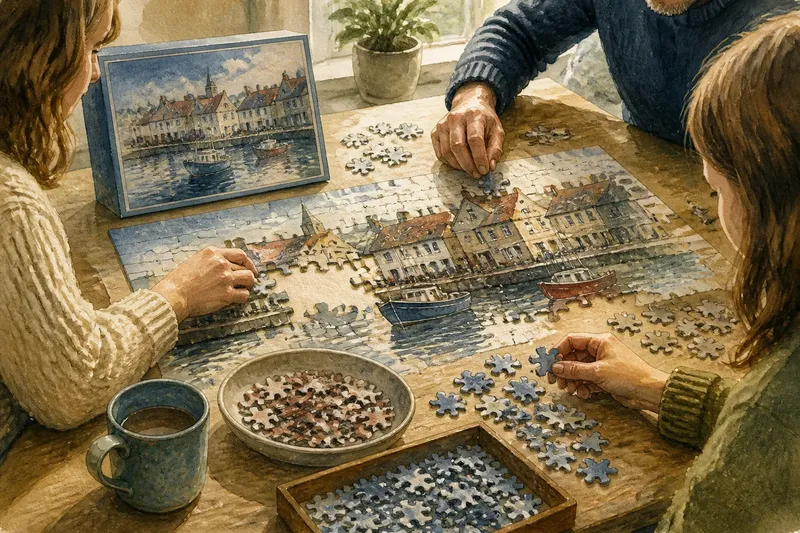
Say a household has an unfinished harbor puzzle on a side table, with the box image showing boats, water, and rooflines. One person places blue-gray pieces near the water, another sorts pieces with sloping roof edges, and a visitor checks a likely fit against the picture; the expected result is a visible connection in the scene, or a rejected piece returned to the sorting area. Either outcome gives the next person a clearer place to start.
That loose structure suits quiet company. A solver who likes methodical sorting and one who prefers scanning the picture can work side by side without needing a score or fixed turns.
Small choices shape a relaxed puzzle session
When choosing a puzzle for a shared table, consider the image, the available surface, and how people prefer to join. These checks lead to practical choices rather than promises about how enjoyable any particular puzzle will be.
- Check whether the image has distinct areas, such as a roof against sky; if those areas are easy to recognize, choose it for casual drop-in solving, but if the image is mostly one similar color, choose a more varied picture.
- Check whether the table can stay in use while the puzzle is out; if it can, leave the work in progress, but if the table is needed, use a puzzle board or choose a smaller project that can be put away.
- Check whether the box includes a reference image; if it does, set it where everyone can see it, but if it does not, agree to sort by visible features rather than expecting newcomers to guess the scene.
- Check how participants like to work; if they enjoy sorting, provide trays or shallow bowls, but if they prefer searching the image, leave pieces mixed and keep the picture nearby.
- Check whether a piece appears to fit by both shape and image; if both align, place it, but if only the color seems right, compare the tabs and gaps before committing.
- Check whether a puzzle session needs to pause; if so, keep loose pieces in a tray and note the area being assembled, but if the surface must be cleared immediately, move the work carefully onto a board or return pieces to the box.
Imagine a household with an available side table, a box showing a harbor, and three people who want to join at different times. They put the box image beside the puzzle, separate roofline pieces into a shallow bowl, and leave water pieces together on the table. The first solver assembles part of a roof, the next checks the picture and adds a matching edge, and the late arrival finds a water piece that does not fit and returns it to the water group. The result is a partially joined roofline and a sorting area that makes the next search easier; the tradeoff is that the table stays occupied until the group pauses or moves the work.
Why did jigsaw puzzles become a household pastime?
What was the purpose of map puzzles?
Some early jigsaw histories describe map puzzles as learning tools: a map was divided into pieces for a learner to reconstruct. For a specific object, verify its origin and intended use rather than assuming every early puzzle served the same purpose.
How can a puzzle work without map knowledge?
A scenic or illustrated puzzle can be assembled by matching shapes, colors, and image details. It may still prompt questions about a place, but solving it does not depend on knowing geography.
Why can people join a puzzle at different times?
The work remains visible as pieces are added, and there is usually no turn order to learn. A newcomer can inspect the picture, sort a small group of pieces, or try one possible fit.
What makes a puzzle feel social rather than competitive?
People can contribute to the same image without keeping score or racing one another. The shared progress is visible in the arrangement on the table, even when each person uses a different approach.
The shared process matters as much as the finished image
A jigsaw puzzle puts a public picture together through many small private decisions. One person notices a color boundary; another recognizes a shape; someone else checks whether the image continues across a seam. Those approaches can coexist without a single pace or method.
The jigsaw puzzle tradition includes more than the moment when the last piece finds its place. Its appeal as a household pastime can lie in returning to an unfinished image, making room for someone else to contribute, and leaving the table easier to rejoin than to explain.
If you want a puzzle to invite casual company, keep the reference image visible and make the unfinished work easy to reach. That small arrangement gives the next person a clear first move without turning a quiet pastime into an assignment.