A Loop Walk or an Out-and-Back? Choose by the View You Want
A loop walk or an out-and-back changes how a day unfolds. Choose the route shape that suits your view, turning point, pace, and appetite for surprise.
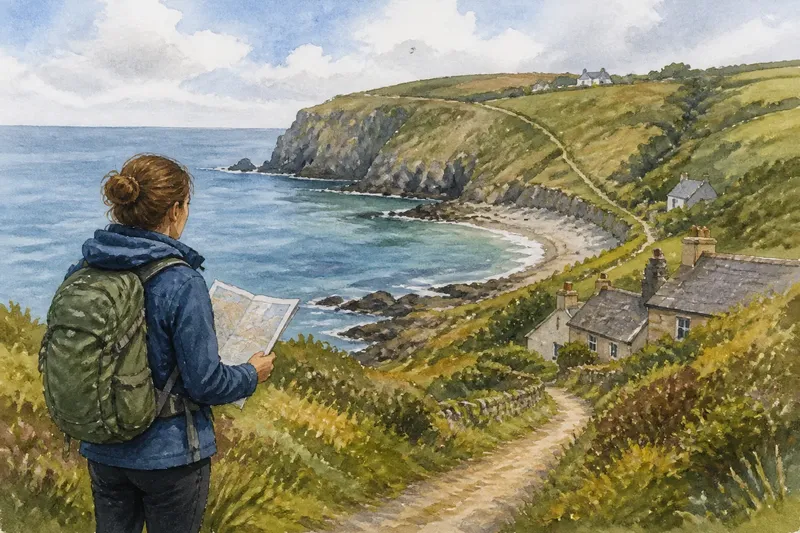
The common mistake with a loop walk or an out-and-back is choosing by shape alone: a loop sounds adventurous, while retracing steps seems dull. That can cost you the best part of the day—a satisfying view, a useful pause, or the freedom to turn around without feeling you have failed to finish.
Route form changes what you see and how progress feels. Imagine a clearly hypothetical outing: Mara has a free afternoon in a northern coastal town, a bus ride to the trailhead, and a preference for open views without a rushed return. Her choice between a loop and an out-and-back depends less on which is more impressive than on what she wants the walk to do.
A loop walk or an out-and-back changes the story of the view
A loop returns to its starting point by a different route. The landscape keeps changing as you move, so a headland, woodland edge, or valley may appear from a new angle on the way back. That variety can make a modest walk feel like a sequence rather than a repeated scene.
An out-and-back follows one route to a chosen turning point, then returns along the same line. The view you walked toward becomes the view behind you. From a ridge, that reversal may reveal a coastline that was hidden at your back; on a narrow forest track, it may feel more familiar than fresh.
Mara pictures the coastal loop first: a path across a bluff, then a sheltered lane back. She likes the prospect of seeing the sea from above and then returning among cottages. But the route map also shows a low stretch near the shore, where wind and tide could shape the day. The loop offers changing scenery, but only if its less exposed section suits the conditions.
On an out-and-back, Mara could walk toward the bluff, enjoy the panorama, and retrace her steps. She would see the same landmarks twice, but the return view would be different, and she could stop at the point that felt right instead of committing to the full circuit.
The turning point gives an out-and-back its purpose
For an out-and-back, the destination need not be a summit or a landmark with a name. It might be the end of a public path, a bench with a view, a bridge over a stream, or simply the point where the terrain begins to feel like more effort than the day calls for.
That gives the route a natural decision. At the turning point, you can pause, look back along the ground covered, and choose whether to continue farther or head home. On a loop, the equivalent choice may be less obvious: once you pass a junction, you may be committed to the remaining arc unless another safe route leads out.
Mara checks the map for a clear place to turn around and notices a sheltered cove partway along the outward track. She decides that the cove will be the day’s destination, not a marker she must pass on the way to a more ambitious one. If the bluff path is busy or the weather shifts, she can still make the cove a complete outing.
A turning point works best when it is chosen before the walk but treated as adjustable. A place to pause is useful; a rigid promise to reach it is not.
Progress feels different on a loop
Loops offer a visible sense of completion: each junction brings you closer to the place where you began, and every new stretch adds another piece of the landscape. That can suit walkers who enjoy discovery and prefer not to retrace a route.
The same quality can make a loop feel less flexible. A path may look like a neat circle on a map but include a steep ascent, an exposed ridge, or a confusing split. The route’s shape does not tell you whether those sections suit your energy, footwear, or the day’s conditions.
Out-and-back progress is easier to read. You know the return follows ground you have already seen, and you can shorten the outing by turning earlier. Yet the distance you walk away from the start also remains to be walked back. A destination that feels close on the outward leg may seem farther once you are tired.
Mara compares the choices by imagining the last part of each walk. On the loop, she would still need to complete the coastal section after reaching the bluff. On the out-and-back, she could stop at the cove and return by a known path. Since her free afternoon is not a race to cover ground, the second shape fits her mood better.
Choose the route form that fits the day
A loop may suit you when variety is the point and the full circuit looks comfortable. An out-and-back may suit you when a particular view matters, you want a clear turning point, or you would like the option to make the walk shorter without solving a new route.
Before setting out, compare more than the outline on the map. Check where paths meet, confirm that the route stays on land open to public access, and make sure the intended track is currently accessible. If a junction offers an alternate way out, identify where it leads before relying on it.
For Mara, the deciding detail is not that one shape is universally easier. It is that the cove gives her a satisfying destination, while the same-path return leaves room to change her mind. She takes the out-and-back, expecting the walk to feel complete even if the bluff remains for another day.
- Check whether the loop’s different landscapes appeal to you; if they do, choose the circuit, and if not, choose a route with a destination you value.
- Check whether a particular viewpoint or landmark anchors your outing; if it does, choose an out-and-back, and if variety matters more, consider a loop.
- Check whether the return follows a familiar path; if flexibility matters, choose that known route, and if novelty matters more, select a circuit whose full route suits the day.
- Check the map for junctions and possible turning places; if there is a clear way to shorten the outing, keep it as an option, and if there is not, choose a route with an easier exit.
- Check the final stretch as carefully as the first; if it still looks manageable, keep the route, and if it does not, choose a shorter or less demanding alternative.
- Check that the path is open to public access and currently accessible; if both are clear, proceed with that route, and if either is uncertain, confirm with the land manager or choose another path.
Which route shape suits your walk?
Is a loop walk always more interesting?
No. A loop can bring changing views, but its appeal depends on the ground it crosses and the landscape you care about. An out-and-back can be compelling when the destination is strong or the return reveals a new angle.
Is an out-and-back easier to shorten?
Often, because you can turn around before reaching the planned destination and retrace the route. The choice still depends on terrain and access, so pick a turning place that makes sense for the walk rather than assuming every point is suitable.
How do I choose a turning point?
Look for a clear place that gives the walk a purpose, such as a viewpoint, bridge, or sheltered stopping spot. Keep it flexible, so changing conditions or your energy can reshape the plan without making the outing feel like a failure.
What should I check before choosing a loop?
Look at the junctions, the character of each section, and how you would respond if you wanted to leave the circuit early. A loop is most satisfying when its whole arc suits the day, not just the stretch nearest the start.
Let the return shape the choice
Mara’s hypothetical outing ends with the cove as her destination and the same track leading back. On the return, the sea is now behind her, and the view opens toward the town; the familiar path does not feel like a duplicate because her direction has changed.
That is the useful question behind a loop walk or an out-and-back: what do you want the return to feel like? Pick a loop for a changing sequence of places, or an out-and-back for a destination and an adjustable turning point. Before leaving, mark the place where you can comfortably decide whether the day is done.